

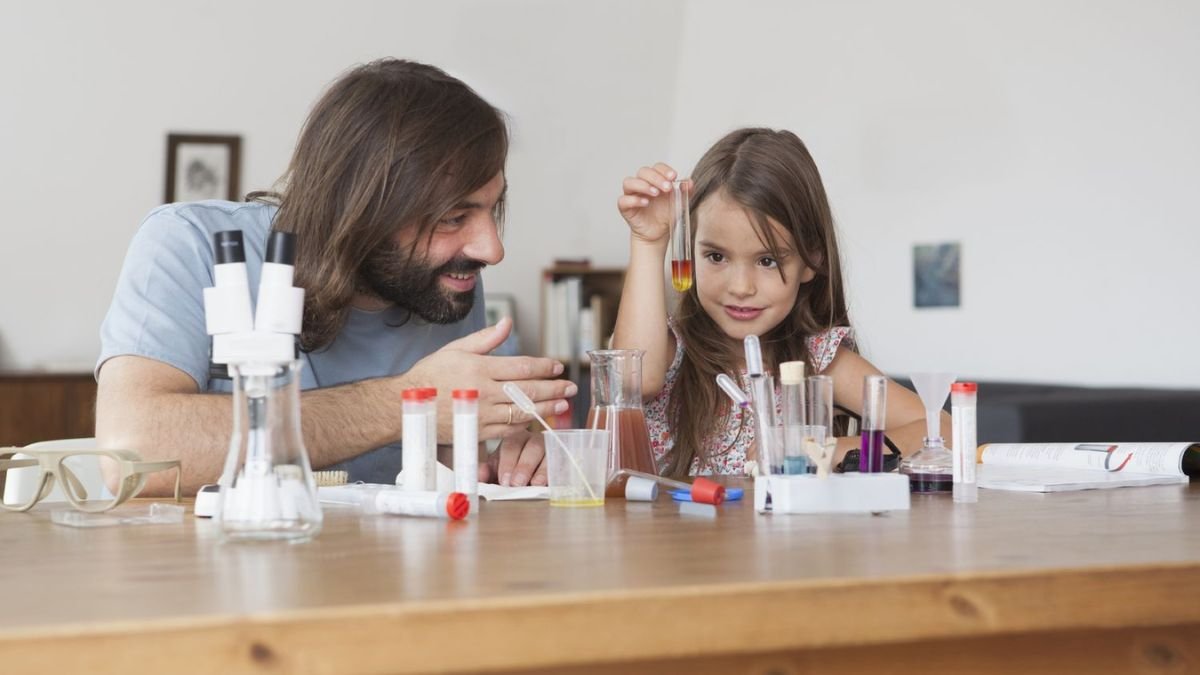
The current era makes studying science at home more accessible and more engaging than any previous time period. People believe that laboratories represent the only safe environment which chemists should use for their work. People can conduct safe and straightforward experiments at home by using everyday items from their households while following safety rules.
The experiments serve as an efficient educational resource which children and adult learners can use to study basic chemistry competencies the experiments below are simple, low-risk, and designed for educational purposes. However, always maintain adult supervision, cleanliness, and safety rules when performing any experiment.
Baking Soda Volcano
This is one of the most popular and safe chemistry experiments. You will only need baking soda, vinegar, a little dish soap, and food coloring.
Pour baking soda into a small container or bottle. Add a few drops of food coloring and a little dish soap. Now slowly add vinegar. As the vinegar reacts with the baking soda, foam will emerge, creating a volcano-like effect.
What did you learn?
The experiment shows how an acid base reaction occurs when vinegar reacts with baking soda. The process produces carbon dioxide gas which creates foam as a result. The method provides an easy way to explain chemical reaction fundamentals to children.
Invisible Ink Experiment
This experiment may seem like magic, but it’s based on simple chemistry. You’ll need lemon juice, a cotton swab, and white paper.
Dip a cotton swab in lemon juice and write something on the paper. Let it dry. The writing will become invisible once it dries. Now, expose the paper to mild heat (such as a light bulb or the gentle heat of an iron). The writing will appear brown in a short time.
What did you learn?
The organic compounds in lemon juice oxidize and change color when exposed to heat. This can help explain the process of oxidation to children
- Rainbow Milk (Magic Milk Experiment)
- This experiment will require milk, food coloring, and dish soap.
- Pour milk into a plate. Add a few drops of food coloring to various areas.
Dip a cotton swab in dish soap and dab it into the milk. Suddenly, the colors will spread rapidly, creating beautiful patterns.
What did you learn?
This experiment demonstrates surface tension and the reaction of dish soap with fat. The dish soap breaks down the fat molecules in the milk, causing the colors to spread rapidly.
Balloon and Gas (Balloon Inflation Reaction)
You need to gather four items which include an empty bottle and baking soda and vinegar and a balloon. The bottle requires vinegar to be poured into it. The balloon should be filled with baking soda and its opening needs to be placed on top of the bottle’s opening. The balloon needs to be straightened so that its contents of baking soda can drop into the vinegar.In a few seconds, the balloon will begin to inflate on its own.
What did you learn?
This is also an example of an acid-base reaction, producing carbon dioxide gas. This illustrates how pressure increases with the formation of gas.
Making Crystals (Salt or Sugar Crystals)
This experiment teaches patience and helps understand crystal structure.
Dissolve salt or sugar in hot water until it is completely saturated. Pour this solution into a clean jar and hang a string from the jar. After a few days, small crystals will begin to form on the string.
What did you learn?
This experiment demonstrates the process of evaporation and crystallization. As the water evaporates, the dissolved substance begins to solidify.
Important Safety Tips
- Although these experiments are considered safe, some precautions are necessary:
- Always perform experiments under adult supervision.
- Do not taste any chemicals.
- Wash your hands thoroughly after use.
- Avoid contact with eyes and skin.
- Do not use materials used in experiments on food.
- Following safety rules keeps the learning experience enjoyable and safe.
Benefits of Learning Science at Home
Home chemistry experiments help children develop their curiosity about science and their ability to observe things and solve problems. The program offers practical training which extends beyond the limits of classroom instruction. When children conduct experiments themselves they gain deeper understanding of scientific principles while building their scientific confidence.
Furthermore, such experiments are a great way to spend time with family. Parents can help their children develop a scientific mindset by experimenting with them.
Conclusion
Chemistry isn’t limited to complex equations and laboratories. It can be made fun and understandable at home through simple and safe experiments. From the reaction of baking soda and vinegar to rainbow milk and crystal formation, each experiment offers a new lesson.
If done with the right guidance and caution, learning chemistry at home is not only safe but also extremely inspiring. Real education is learning science by connecting it to everyday life.




Leave a Reply